Learn Japanese with Japanese Friends!
Blue House Okinawa
Japanese School
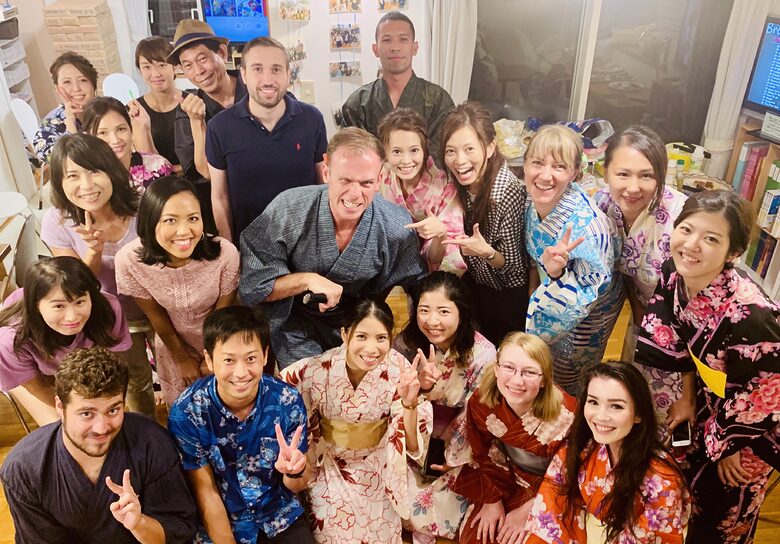
Learn Japanese for the Conversations You Want to Have in Okinawa
Ask a local where they love to eat, what they enjoy about Okinawa, or anything you’ve been curious about.
At Blue House Okinawa, you learn step by step, practice in class, then use your Japanese in Language Exchange with local people who are learning English too.
Already Know What You’re Looking For?
¥55,400 / 2 Months with Early Bird
¥66,500 / 2 Months with Regular
Registration Fee: ¥11,000
Beginners 1 & 2 Materials: ¥7,700
First Time Payment
By the 20th: ¥74,100
After the 20th: ¥85,200
On This Page
Living in Okinawa, have you wondered;
- I always go to the same restaurants. Where do local people in Okinawa like to eat?
- I’ve been looking for a specific item off base but can’t find it. Where do local people shop?
- I separate my trash, but the garbage collector won’t take it. How do people here sort their garbage?
- I don’t need to become fluent in Japanese. I just want to learn useful phrases for everyday life.
Or studying Japanese, have you wondered;
- I study grammar, vocabulary, and phrases, but I don’t know how to use them in a real conversation.
- I can’t keep up when native Japanese speakers talk. Where can I practice listening and speaking?
- I’m not sure if my pronunciation is right. Could a native speaker help me check it?
- I’d like Japanese friends to practice with and help me stay motivated.
We have answers!
Ask Local Japanese Your Questions!
You don’t need to be fluent to start a conversation. At Blue House Okinawa, you can meet local Japanese students who are learning English too.
Ask where they like to eat, shop, or spend time. Practice Japanese together, hear how people use words and phrases in conversation, and help each other learn.
Learn real Japanese through real conversations with local people.
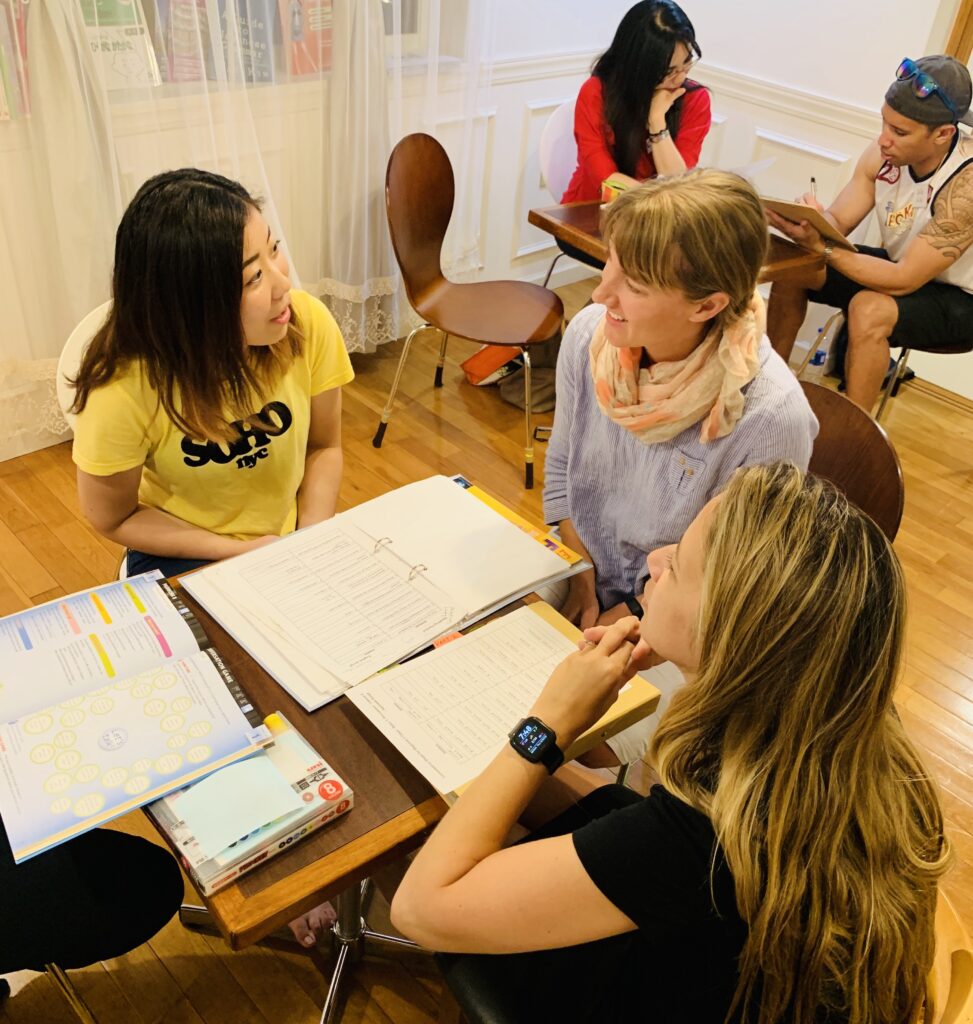
You’ve Studied Japanese. So Why Is Speaking Still So Hard?
You may know grammar, vocabulary, and useful phrases, yet still freeze when someone speaks to you in Japanese.
You might worry that you’ll say something wrong, mispronounce a word, or understand only part of the answer.
That doesn’t mean you’re bad at Japanese.
A real conversation is different from studying on your own: people answer in their own words, speak at their own pace, and keep the conversation moving.
You need a chance to practice using the Japanese you know with another person.
You Don’t Have to Be Fluent to Start
At Blue House Okinawa, you can bring your questions to class, check your Japanese and pronunciation with your instructor, and practice saying what you want to ask.
Then, through Language Exchange, you can try using it with local Japanese students who are learning English too.
What If I Don’t Understand?
You don’t have to understand every word or know exactly what to say next.
You can ask someone to repeat their answer:
もういちどいってください。
Could you say that one more time?
Start with one question, listen to what you can, and respond with the Japanese you know.
You and the Japanese students are both learning, so you can practice, make mistakes, and help each other along the way.
You don’t need perfect Japanese to begin.
You just need a place to start—and a chance to use what you’re learning.
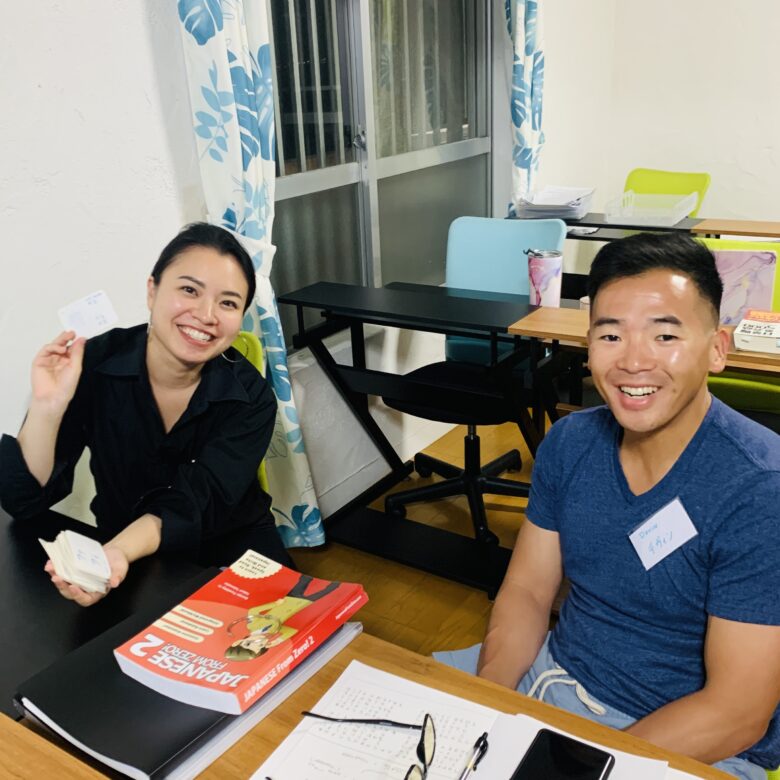
From Learning to Using
Knowing Japanese when the answer is in front of you and being able to bring it back on your own are two different things.
The first time you meet new Japanese, most of your attention goes to understanding it.
That is important, but understanding is only the beginning.
To use Japanese in a real conversation, you also need chances to remember it without looking, connect it to your own life, check it, and try it with another person.
The goal is not simply to recognize the answer.
It is to be able to bring the Japanese back when you need it.
See how our curriculum has built
Everything You Need to Study Japanese
Blue House Okinawa connects the steps above so the Japanese you study has somewhere to go.
We kept asking the same question: What should happen before a student is asked to speak?
For classes that include home study, we moved more of the reviewing and preparation outside the classroom so class time could be used for questions, pronunciation, practice, feedback, and speaking.
We did not add online tools just to make the class more digital.
We added them to make more room for practice.
The tools are not the destination. They prepare you for what comes next.
Textbook — Learn It
Your textbook introduces the vocabulary, grammar, expressions, and activities for each lesson.
It gives you the new Japanese you will keep working with as you review, prepare, practice, and eventually use it.
Study Room — Recall It
The Study Room is Blue House Okinawa’s online learning space. You can review vocabulary and expressions from your lesson with Flashcards with Audio and Quizzes.
The point is not only to recognize an answer when you see it. You practice bringing the Japanese back from memory so it is easier to recall later when you actually need it.
Workbook — Make It Yours
The Workbook helps you take the grammar and vocabulary from your lesson and connect it to your own life.
Instead of asking only, “What should I study?” you can begin asking, “What do I want to be able to say or understand next?”
Use what you study to prepare questions and answers about your work, weekend, family, interests, plans, and experiences. Preparation gives you something specific to ask, answer, check, or try in class.
The point of preparation is to give your next conversation something to start with.
Bring It Back to Class — Check It and Practice It
In class, you bring that Japanese with you.
Each lesson has two parts.
In the first half of the lesson, you work with your instructor. Ask the questions that came up while you were studying, check the wording, check your grammar and pronunciation, say what you prepared out loud, get feedback, and try again.
This first part gives you time to clarify and practice the Japanese before you use it with another person.
Then, in the second half of the lesson, the class moves into Language Exchange.
Language Exchange — Use It
A teacher can help you check the Japanese, but a real conversation shows you what happens when the answer is not the one you practiced.
In the second half of the lesson, Language Exchange gives you a place to take some of the Japanese you studied and practiced and try using it with another person.
Ask a question. Listen to the answer. If you miss something, ask again.
“Mou ichido itte kudasai.” — “One more time, please.”
You might understand the whole answer, or you might catch only a few words. Sometimes catching one more word the second time is enough to keep the conversation going.
A real answer may be different from the answer you practiced. That is part of the learning.
Every Conversation Gives You Something to Bring Back
- I study grammar, vocabulary, and phrases, but I don’t know how to use them in a real conversation.
- I can’t keep up when native Japanese speakers talk. Where can I practice listening and speaking?
- I’m not sure if my pronunciation is right. Could a native speaker help me check it?
- I’d like Japanese friends to practice with and help me stay motivated.
Learn Japanese with Japanese Friends!
Blue House Okinawa
Japanese School
More than a Class
Class may end for the day, but the people, conversations, and reasons to keep using Japanese don’t always have to end there.
The connection doesn’t have to disappear when the lesson ends.
Sometimes it’s simply useful language practice. Sometimes a conversation leads to studying together, learning something about another person, or becoming happy to see someone again.
Japanese can start connecting not only to what you study, but also to the people you meet and the experiences you have while living in Okinawa.
What Our Studnets Say
What Liam san & Grace san from our Japanese conversation class have to say about:
– Blue House Okinawa
– Our Japanese Conversation Class
– Living in Okinawa
What Connor san & Noah san from our Japanese self-paced class have to say about:
– Blue House Okinawa
– Why They Started Learning Japanese
– How They Study Japanese
– Tips for Learning Japanese
What Other Studnets Say
Since arriving in Okinawa, Blue House has been an extremely friendly and encouraging environment to begin learning Japanese!
The evening classes have been a perfect fit for my busy work schedule and helps me set goals within designated lesson plans.
The biggest advantage from blue house is the ability to practice pronunciation, overall speaking ability, and receive real feedback. It is hard to take the first steps into learning a new language but every class I have attended has made me feel comfortable with making mistakes/challenging to do better.
It has been rewarding using new vocabulary or sentence structures learned throughout the course and applying it to daily life here in Japan.
This is why the unique addition of the language exchange with other Japanese students at the end of each class is something I look forward to every time.
On top of the in house learning, they have provided a structure that helps me study throughout the week as well.
Given that learning Japanese can be very difficult to begin, this is very useful in creating a focus point and tracking progress made.
As I have just completed my first course, I will be taking the next one and highly recommend for someone who wants the extra push to become more involved with learning Japanese language/culture while living in Okinawa.

I remember my first class at Blue House Okinawa!
I was brand new to Okinawa and the Japanese language.
I was able to have basic exchanges, and it made me so happy to practice with native speakers and have such a fun community to learn in.
I’m two years into studying now and am so glad I found Blue House Okinawa from the beginning — it introduced me to some of my favorite people in Okinawa and is such a special place ❤️
A few points: 1. This is not a traditional school — they utilize the “flipped classroom” and “blended learning” models (if not familiar, google those terms. They’re interesting!).
Independent learners thrive here!
2. Since this is both an English & Japanese language school, I love that there are opportunities to both learn Japanese and help others learn English through Blue House’s conversational exchange club, read aloud club, and public speaking practice in our target language.
If you’re someone who takes initiative, there are so many real-life practice opportunities and study buddies here!
Beyond language-learning, I’ve loved the extra curriculars (trips, hikes, karaoke, BBQs, field trips).
It’s a wonderful group of people making a community learning program come to life!
It’s really made my time in Okinawa extra adventurous and interesting!

I had spent about 8 months using online based methods to learn Japanese.
Blue House Okinawa gave me the opportunity to learn Japanese face-to-face with native Japanese speakers.
The language exchanges forced me to step outside of my shell and speak among our Japanese peers, which was exactly what I needed to do to gain confidence to apply my classroom learning to the real world.
Most importantly, it has been an incredibly fun experience to learn Japanese while helping others to learn English!

Making the decision to start studying Japanese at Blue House has been absolutely incredible!
Not only do we have a solid curriculum and get in class help with great teachers, we also have the opportunity to work with Japanese students that are learning English.
The language exchange portion of class, where we help these students learn English – and they our Japanese – is my favorite!
It’s really helpful to hear all of different pronunciations and dialects when you’re learning Japanese.
Also, it’s a wonderful place to make friends as well✨

Blue House Okinawa is my family!
We are leaving island soon and Blue House Okinawa was really the best part of my Okinawa experience.
It’s worth every penny.
Learning Japanese at Blue House Okinawa is fun and very.
I have made friends here and Monica sensei is kind and patient.
My classmates are also kind.
Japanese is hard and I get shy when I talk in Japanese but Blue House Okinawa helps me learning.

There Is a Place to Start, Even with Zero Japanese
You Don’t Have to Figure Out the Whole Learning Path Before You Begin
You don’t need to know Japanese before you begin.
Beginners 1 Class is the starting point for complete beginners.
If you’re looking at Hiragana, grammar, speaking, textbooks, apps, and different class options and wondering what you’re supposed to do first, you don’t need to solve all of that before you start.
There is a clear place to begin.
Beginners 1 Class
Beginners 1 Class is the main starting point if you want Japanese to become a regular part of your week.
You’ll begin with pronunciation, Hiragana, greetings, self-introduction, useful vocabulary, basic sentence patterns, and simple questions.
Between lessons, you can review and prepare, then bring your questions back to class.
Program Details
- Duration: 2 months
- Frequency: 2 lessons per week
- Total: 16 lessons
- Level: Complete beginners
- Focus: Pronunciation, Hiragana, basic grammar, vocabulary, listening, and speaking
Beginners 1 Lecture Class Schedule
Monday 6:20–7:30 PM & Wednesday 8:10–9:20 PM
November-December 2026
2 Nov – 24 Dec, 2026
January–February 2027
4 Jan – 25 Feb, 2027
May–June 2027
3 May – 24 Jun, 2027
August–October 2027
30 Aug – 28 Oct, 2027
Before You Enroll
Beginners 1 Lecture Class uses a Fixed Schedule.
Your class days and times remain the same during the two-month term.
If you miss a Fixed Schedule lesson, it cannot be rescheduled or made up.
Pay by the 20th of the previous month to receive the Early Bird rate.
Schedule
Monday 6:20–7:30 PM & Wednesday 8:10–9:20 PM
Duration: 2 months
Frequency: 2 lessons per week / 16 lessons total
Total Tuition
Tuition:
¥55,400 by the 20th
¥66,500 after the 20th
Registration Fee:
¥11,000
Beginners 1 & 2 Class Materials:
¥7,700
First Payment Total
By the 20th: ¥74,100
After the 20th: ¥85,200
Have Only One Month to Study Japanese?
The Same Beginning in One Focused Month
If you have more time right now and want to build momentum quickly, Intensive Beginners 1 gives you the same beginner foundation over four focused weeks.
Because you’re back in class four days a week, there’s less time between lessons to forget what you just learned. You can keep practicing, asking questions, and building while the Japanese is still fresh.
Program Details
- Duration: 4 weeks
- Frequency: 4 lessons per week
- Total: 16 lessons
- Level: Complete beginners
- Focus: Hiragana, basic grammar, vocabulary, listening and speaking
2027 Intensive Beginners 1 Lecture Class Schedule
Monday–Thursday 3:10–4:20 PM
December 2026
30 Nov – 24 Dec, 2026
January 2027
4 Jan – 28 Jan, 2027
March 2027
1 Mar – 25 Mar, 2027
May 2027
3 May – 27 May, 2027
July 2027
5 Jul – 29 Jul, 2027
September 2027
30 Aug – 23 Sep, 2027
November 2027
1 Nov – 25 Nov, 2027
Before You Enroll
Intensive Beginners 1 uses a Fixed Schedule.
You attend four lessons per week for one month.
Your class days and times remain fixed during that Intensive term.
Schedule
Monday–Thursday 3:10–4:20 PM
Duration: 4 weeks
Frequency: 4 lessons per week / 16 lessons total
Total Tuition
Tuition:
¥55,400 by the 20th
¥66,500 after the 20th
Registration Fee:
¥11,000
Beginners 1 & 2 Class Materials:
¥7,700
First Payment Total
By the 20th: ¥74,100
After the 20th: ¥85,200
Which Beginners 1 Option Fits You?
Beginners 1 Class
A regular class twice a week
Intensive Beginners 1
A focused month with class four days a week
Same foundation. Different pace.
What If Beginners 1 Isn’t What You Need?
Beginners 1 is designed for people who are completely new to Japanese. But you may have a different goal, or you may already know some Japanese. Choose the option that best fits you.
Want to Focus on Speaking?
The Japanese Conversation Class may be a good fit for you.
Japanese Conversation Class
Practice speaking and understanding Japanese for everyday situations, such as ordering at restaurants, shopping, and getting around. You can also work on pronunciation and listening. There is no required homework or pre-study.
Want to Learn at Your Own Pace?
Self-Paced Japanese Classes may be a good fit if you want to study on your own schedule.
Self-Paced Japanese Classes
Work through structured Japanese lessons at a pace that works for you, with instructor support when you need it.
You can study at your own pace and still get instructor support.
Have You Studied Japanese Before?
If you already know some Japanese, you may be able to start beyond Beginners 1.
Compare the Japanese taught at each level to find where the material starts to feel new to you.
School Calendar
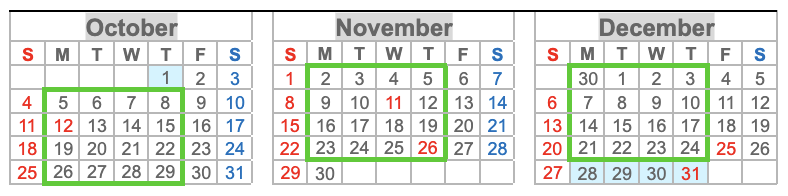
2026 School Calendar
Fall
Fall Break : 25 Sep – 4 Oct
October : 5 Oct – 29 Oct
November : 2 Nov – 26 Nov
December : 30 Nov – 24 Dec
Winter Break : 25 Dec ‘26 – 3 Jan ‘2
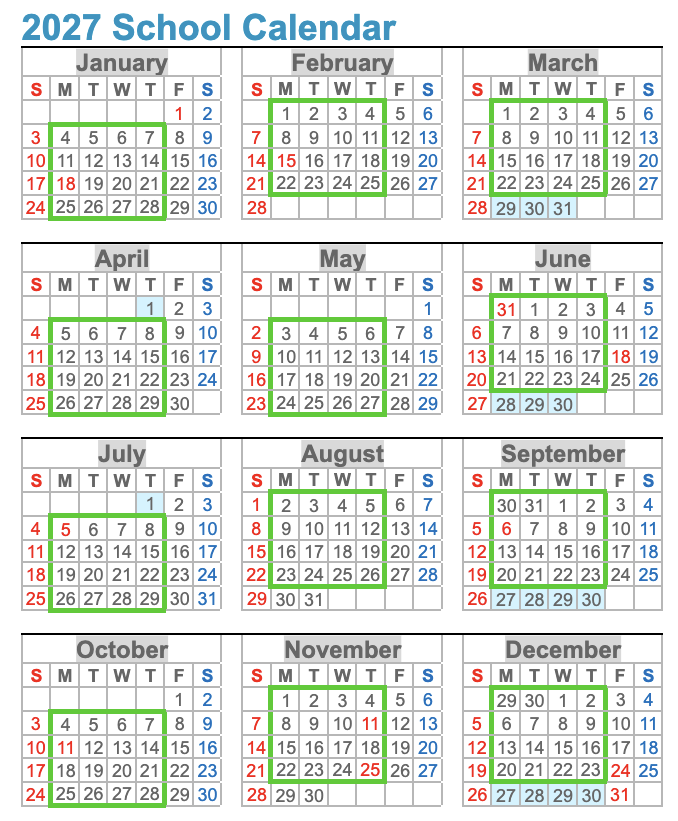
2027 School Calendar
Winter
Break: 28 Dec ‘26 – 31 Dec ‘26
Jan: 4 Jan – 28 Jan
Feb: 1 Feb – 25 Feb
Mar: 1 Mar – 25 Mar
Spring
Break: 29 Mar – 1 Apr
Apr: 5 Apr – 29 Apr
May: 3 May – 27 May
Jun: 31 May – 24 Jun
Summer
Break: 28 Jun – 1 Jul
Jul: 5 Jul – 29 Jul
Aug: 2 Aug – 26 Aug
Sep: 30 Aug – 23 Sep
Fall
Break: 27 Sep – 30 Sep
Oct: 4 Oct – 28 Oct
Nov: 1 Nov – 25 Nov
Dec: 29 Nov – 23 Dec
Winter Break : 27 Dec ‘27 – 30 Dec ‘27
2026 School Calendar
Evening Beginners 1 / Conversation 1 Class:
2 Lessons Per Week for 2 Months
Mon 6:20pm – 7:30pm & Wed 8:10pm – 9:20pm
- 2 Nov – 24 Dec, 2026 Beginners 1
- 4 Jan – 25 Feb, 2027 Beginners 1
- 1 Mar – 29 Apr, 2027 Conversation 1
- 3 May – 24 Jun, 2027 Beginners 1
- 5 Jul – 26 Aug, 2027 Conversation 1
- 30 Aug – 28 Oct, 2027 Beginners 1
- 1 Nov – 23 Dec, 2027 Conversation 1
Daytime Intensive Beginners 1 / Conversation 1 Class:
4 Lessons Per Week for 1 Month
Mon – Thu, 3:10pm – 4:20pm
- 2 Nov – 26 Nov, 2026 Conversation 1
- 30 Nov – 24 Dec, 2026 Beginners 1
- 4 Jan – 28 Jan, 2027 Beginners 1
- 1 Feb – 25 Feb, 2027 Conversation 1
- 1 Mar – 25 Mar, 2027 Beginners 1
- 5 Apr – 29 Apr, 2027 Conversation 1
- 3 May – 27 May, 2027 Beginners 1
- 31 May – 24 Jun, 2027 Conversation 1
- 5 Jul – 29 Jul, 2027 Beginners 1
- 2 Aug – 26 Aug, 2027 Conversation 1
- 30 Aug – 23 Sep, 2027 Beginners 1
- 4 Oct – 28 Oct, 2027 Conversation 1
- 1 Nov – 25 Nov, 2027 Beginners 1
- 29 Nov – 23 Dec, 2027 Conversation 1
Self-Paced Class
For the current 2-lessons-per-week Fixed Self-Paced option, choose one Tuesday and Thursday pair.
- Tuesday & Thursday, 1:15–2:25 PM
- Tuesday & Thursday, 6:20–7:30 PM
- Tuesday & Thursday, 8:10–9:20 PM
The same lesson time is reserved each Tuesday and Thursday during the plan.
If you miss a Fixed lesson, it cannot be rescheduled, made up, or refunded.
Want to understand what you actually do in a Self-Paced class?
Want to see how home study, Workbook, class, and real practice connect?
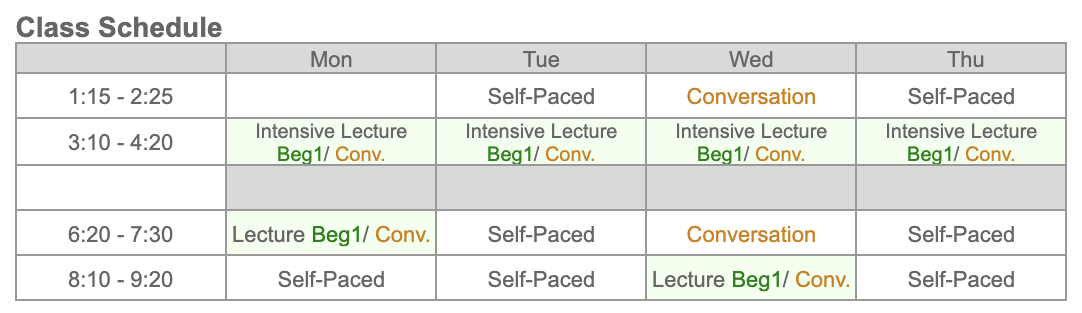
Class Schedule
Before comparing tuition, look at when Japanese classes are available during the week.
Beginners 1 and Conversation 1 Lecture / Intensive-Lecture alternate during the year.
Flex students can book from Japanese classes available on the weekly schedule.
A Few Things You May Still Be Wondering About?
I Don’t Know Any Japanese. Can I Start?
-Yes. Beginners 1 starts from zero.
I’ve Studied Before. Do I Have to Start Over?
-No. Compare the actual Japanese in each level and start where the material begins to feel new.
What If My Schedule Changes a Lot?
-Self-Paced and Flex options may work better if a Fixed Schedule doesn’t fit your life.
Do I Have to Take a Trial Lesson First?
-No. You can enroll directly if you already know which class you want.
If you’d rather visit first, ask questions, and get a clearer idea of where to start, a Trial Lesson is available for ¥2,200.
Still Have a Practical Question Before You Start?
If you know which course you want but still have a question about finding Blue House, parking, class schedules, or what to do before you arrive, you do not need to search through the other pages one by one.
Blue House Okinawa is near Sunabe Seawall, close to Kadena Air Base Gate 1.
Blue House Okinawa does not have its own parking lot.
If you are driving, please park along Sunabe Seawall and walk to the school from there.
Please do not park directly in front of Blue House Okinawa or along the surrounding residential streets.
Ready to Start?
Beginners 1 Lecture Class
Monday 6:20–7:30 PM & Wednesday 8:10–9:20 PM
Duration: 2 months
Frequency: 2 lessons per week / 16 lessons total
¥55,400 / 2 Months with Early Bird
¥66,500 / 2 Months with Regular
Registration Fee: ¥11,000
Beginners 1 & 2 Materials: ¥7,700
First Time Payment
By the 20th: ¥74,100
After the 20th: ¥85,200
Beginners 1 Intensive Class
Monday–Thursday 3:10–4:20 PM
Duration: 4 weeks
Frequency: 4 lessons per week / 16 lessons total
¥55,400 / 4 Weeks with Early Bird
¥66,500 / 4 Weeks with Regular
Registration Fee: ¥11,000
Beginners 1 & 2 Materials: ¥7,700
First Time Payment
By the 20th:¥74,100
After the 20th: ¥85,200